Quick Summary: "Certificado de antecedentes judiciales emitido por la autoridad federal (FBI), apostillado en Washington DC Distrito de Columbia y traducido, con una vigencia no mayor a 3 meses" means Cancillería wants an FBI criminal record certificate, apostilled by the U.S. Department of State in Washington, D.C., translated into Spanish by an official translator, and issued no more than 3 months ago.
- This is a requerimiento — Cancillería asking for a missing document, not denying your visa. You get up to three on one application.
- Only the U.S. Department of State in Washington, D.C. can apostille an FBI report. A state Secretary of State apostille is rejected.
- Apostille first, translate second, so the official translation covers the FBI report and the apostille as one packet.
- The 3-month clock runs from the FBI's issue date — not the apostille date and not the translation date.
- Self-managed, the full sequence commonly runs 3–4 months, which is why so many packets fail the 3-month test on a date rather than on a document.
That is the short version. Here is why it landed in your inbox looking like the end of the world.
The letter does not say denied — it says "Certificado de antecedentes judiciales emitido por la autoridad federal (FBI), apostillado en Washington DC Distrito de Columbia y traducido, con una vigencia no mayor a 3 meses," and somehow that feels worse, because at least denied is a word you understand.
You had spent months getting everything in order. The birth certificate you had to request from a county office in another state. The bank statements, printed and re-printed because the first set was a day too old. The photo with the white background. The passport scans, named exactly the way the portal insisted. You uploaded the last file, paid the visa fee, and then did the only thing left to do, which was wait.
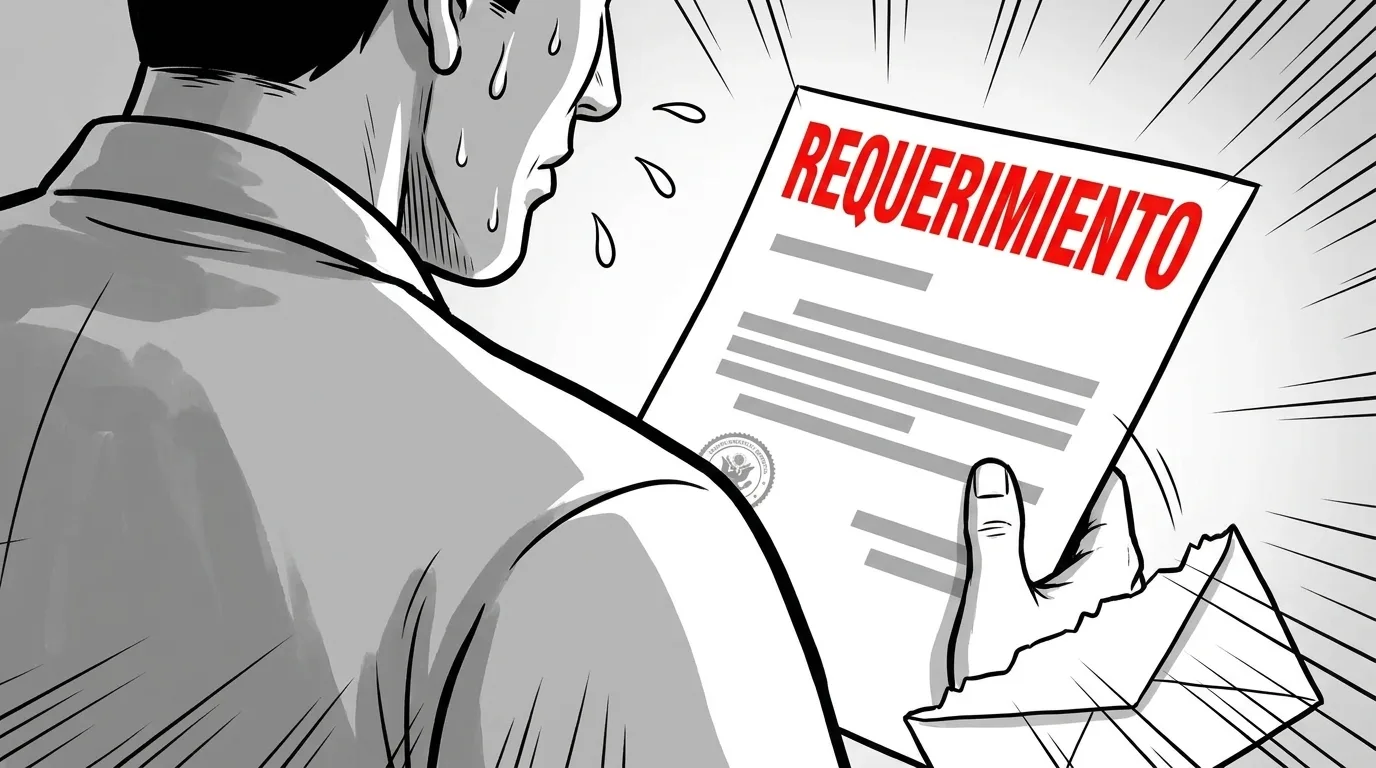
The reply came a week or two later. There is a half-second before you open an email like that where you let yourself believe it's the approval — and then the page loads and it is dense, formal Spanish, and your eye catches on no mayor a 3 meses and on the word requerimiento, and there is a deadline attached to it. You read it twice. You do not recognize half the vocabulary. What you do recognize is the tone: clipped, procedural, final. It reads like the end of something.
It isn't. Read that paragraph again and it turns into something much smaller than it looks: Cancillería is telling you that one document is missing, and telling you — in the most bureaucratic phrasing available to it — exactly which one.
Every clause in that sentence is a rejection trap, and the people who lose weeks on this requirement almost always lose them to the same three: they get the wrong apostille, they translate in the wrong order, or they start early enough that the document is stale by the time they submit it.
What Cancillería is actually asking for
Three conditions, all mandatory
FBI report — federal
✓ FBI Identity History Summary
Not a state, county, or private check
Apostille from Washington, D.C.
✓ U.S. Department of State only
A state Secretary of State = rejected
Official Spanish translation
✓ Sworn translator, after apostille
Report must be under 3 months old
First: A Requerimiento Is Not a Denial
The message you received is a requerimiento — a formal request for missing documents or missing formalities. It is the visa authority telling you your file is incomplete, not that your application failed.
Under Resolución 5477 de 2022, the rule that governs Colombian visas, the Visa and Immigration Authority can issue a requerimiento up to three times on the same application (Art. 11, parágrafo, and Art. 19). That's your real budget. Every wrong document you upload burns one of those three chances and restarts the review clock — which is why answering it correctly the first time matters more than answering it fast.
Two things to do before anything else:
- Read the deadline on your own requerimiento notice. The resolution sets a 30-calendar-day window for the authority to rule (Art. 13), not a universal window for you to respond. Your notice states its own response deadline. Treat that date as hard.
- Check your immigration status in Colombia. If you're inside the country while this is pending, you must stay in legal status the entire time the application is being processed. If your entry stamp is running out, that's a separate fire — handle it with a tourist visa extension or a salvoconducto before it lapses.
"Antecedentes Judiciales (FBI), Apostillado en Washington DC y Traducido" — Decoded Clause by Clause
"Certificado de antecedentes judiciales emitido por la autoridad federal (FBI)"
Criminal record certificate issued by the federal authority (FBI).
They want the FBI Identity History Summary — the nationwide, fingerprint-based record check run by the FBI's Criminal Justice Information Services division. It's the document most Americans call an "FBI background check."
What does not satisfy this clause:
- A state police or state bureau of investigation record (Florida FDLE, Texas DPS, California DOJ, etc.)
- A county courthouse record search
- An employment background check from a commercial screening company
- A local police clearance letter
- The Colombian antecedentes judiciales certificate from the Policía Nacional — that's a different document, and if your requerimiento asks for both, you need both
The word federal is there on purpose. Cancillería is explicitly naming the issuing authority so there's no ambiguity, because state-level records are the single most common substitution applicants try.
"apostillado en Washington DC Distrito de Columbia"
Apostilled in Washington, D.C.
This is the clause that causes the most expensive mistakes, so read it carefully: an FBI report is a federal document, and federal documents can only be apostilled by the U.S. Department of State, Office of Authentications, in Washington, D.C.
No state Secretary of State can apostille an FBI report. Not the state you live in, not the state where you were fingerprinted, not the state where you were born. If you send an FBI report to a state office, it comes back rejected — and you've lost the mailing time in both directions. (If you want the full background on the two-track apostille system, we wrote a plain-language explainer: what it means to apostille a document.)
Cancillería spelled out "Washington DC Distrito de Columbia" in your requerimiento precisely because they've seen state apostilles on FBI reports before, and they don't accept them.
Mechanically, the DIY federal route means: form DS-4194, a $20 fee per document, a prepaid express return envelope, and mailing it to the Office of Authentications. Self-submitted processing by mail is commonly quoted at 6–8 weeks — and that's the number that quietly destroys the 3-month validity window we'll get to in a moment. Errors on the DS-4194 are the single most common reason a submission comes back unprocessed.
Two more federal-apostille details that get documents bounced:
- Print the FBI's PDF exactly as issued. The FBI (or an FBI-approved channeler) delivers your result as a PDF with a watermark and an official's signature. Print it on letter paper, unresized, unreformatted, uncompressed. A scan of a printout is rejected.
- Don't notarize it. An FBI report doesn't need a notary before the federal apostille, and adding one creates a document the Office of Authentications has to reason about.
"y traducido"
And translated.
Article 21 of Resolución 5477 requires every document created or issued abroad to carry an apostille or legalization and an official Spanish translation (traducción oficial) when it isn't already in Spanish. "Official" is a legal status here, not a quality adjective — it means a translator recognized as an official translator, with a seal, a resolution number, and a signature.
Google Translate output, a bilingual friend, and a generic "certified translation" from a U.S. online service are not traducción oficial.
The sequencing rule almost everyone gets wrong: apostille first, translate second. Cancillería's own guidance is that a document requiring translation should be apostilled and then translated, so the translation covers the base document and the apostille as one packet. If you translate first and apostille afterward, you generally end up paying to translate the whole thing again.
There's also a cost difference depending on where the translation is done:
- Translated in Colombia by an official translator, for use in Colombia — since December 1, 2020, that translation does not need to be apostilled or legalized. The translator's signature is already valid on Colombian soil. This is the cheaper, faster path.
- Translated abroad — the translation itself has to be apostilled or legalized in the country where it was produced, which adds another federal or state process, more mailing, and more weeks.
Last translation trap: Colombian authorities expect the entire document translated by a single sworn translator. A partly translated report, or one stitched together from two translators, gets rejected. Our certified translation service is $99 per document for up to two pages and $30 per additional page — and almost every FBI report is exactly two pages.
"con una vigencia no mayor a 3 meses"
Valid for no more than 3 months.
Article 20 of Resolución 5477 says supporting documents other than your passport must carry an issue date no more than three (3) months before the application is registered. Your requerimiento restates it because it's the condition most likely to fail on a re-submission.
The part that catches people: the 90 days run from the FBI's issue date, not the apostille date and not the translation date. The apostille doesn't reset the clock — it certifies a document that is already aging. An FBI report pulled in March, apostilled in June, and translated in July is a four-month-old document no matter how fresh the apostille looks.
So the practical standard is: your FBI report should be as recent as you can make it, and the apostille and translation should be fast enough that the packet is still comfortably inside 3 months when it lands in the portal. If you're near the edge, pull a new report. It's cheaper than burning one of your three requerimientos.
The Timeline Math — This Is the Whole Problem
Here's why the DIY route so often fails the 3-month test even when every single document is correct:
| Step | Doing it yourself | With OnCallColombia (VIP) |
|---|---|---|
| Fingerprints | Find an ink FD-258 provider, mail the card to the U.S. | Technician comes to your home, hotel, or office — digital capture |
| FBI report | 2–4 weeks (mail-in), plus international shipping each way | Submitted electronically — results typically in 24–48 hours |
| Federal apostille | Mail to the Dept. of State; commonly 6–8 weeks | ~10 business days, hand-delivered in Washington, D.C. |
| Official translation | Find a sworn translator; apostille it too if done abroad | Included — sworn translator, no extra apostille needed |
| Realistic total | 3–4 months | As fast as 10–15 business days |
Read the left column against a 90-day validity window. A self-managed process that starts the day the requerimiento arrives can easily deliver an apostilled, translated packet where the FBI report is already older than 3 months — a perfect document that fails on a date.
That's not a hypothetical. It's the most common reason a second requerimiento arrives.
What to Do Right Now
If you don't have an FBI report yet — or yours is more than a few weeks old:
- Get fingerprinted and submitted electronically so the report comes back in 24–48 hours instead of weeks. Our FBI background check service in Colombia sends a technician to you in Medellín, Bogotá, Cali, Pereira, Santa Marta, or Cartagena — no flight to the U.S., no embassy appointment. (If you're weighing providers, here's every option compared.)
- Send the report straight to the U.S. Department of State for the federal apostille.
- Translate the apostilled packet with a sworn translator.
- Upload to the visa portal well inside the 90 days.
If you already have a current FBI report (issued within the last few weeks):
Skip step one. Our FBI apostille service is a $200 flat fee, roughly 10 business days, and returns a ready-to-use scan — you upload the PDF, we walk it into the Department of State. Add the translation and you're done.
Either way, don't upload a partial answer. A requerimiento answered with the FBI report but no apostille, or with an apostille but a non-official translation, is a wasted attempt out of three.
Where This Sits in the Colombian Visa Process
Most people meet the requerimiento with no idea what stage they're at or what happens after. Here's the full sequence under Resolución 5477, so you know what's ahead.
Stage 1 — Register the application and pay the study fee
You file online through Cancillería's visa portal, upload the form, photo, passport pages, and the documents specific to your visa category. The system issues a reference number. From that moment you have 10 calendar days to pay the study fee (tasa de estudio) — miss it and the application is treated as withdrawn, with no ruling issued (Art. 11). Fee amounts change; check Cancillería's current published rates rather than a number you read in a forum.
Stage 2 — Study
The Visa and Immigration Authority has up to 30 calendar days to rule (Art. 13). If they need to consult another agency — Migración Colombia, police databases, another ministry — it can run longer. During this whole period you must remain in regular immigration status if you're inside Colombia.
Stage 3 — The ruling
Four possible outcomes:
- Aprobada — approved, move to Stage 4.
- Requerimiento — additional documents or formalities needed. This is where you are. Up to three of these per application.
- Inadmisión — the application doesn't move forward as filed.
- Negación — denied.
The authority may also verify criminal records directly (Art. 26) — it can check the Colombian Policía Nacional database itself, and separately require records from your country of nationality or residence. That's the legal hook behind your FBI requirement.
Stage 4 — Pay the issuance fee
Once your visa is authorized, you have 10 calendar days to pay the issuance fee (Art. 12). Miss that window and it's interpreted as withdrawal of the application — approval and all. The electronic visa is issued after payment.
Stage 5 — Register with Migración Colombia and get your cédula de extranjería
For any visa valid more than 3 months, you must register with Migración Colombia and apply for the cédula de extranjería within 15 calendar days — counted from your entry into Colombia, or from the visa's issue date if you were already in the country. Late registration means fines. Appointments are scarce in high season, so book the moment your visa is stamped.
What to expect right after you upload the FBI packet
- The file goes back into review. Expect the clock to restart, not resume — plan for weeks, not days.
- A second requerimiento is possible, on this document or a different one. You have three total.
- Nothing about the requerimiento pauses your immigration status. If your permitted stay expires while you wait, extend it — a lapse can complicate the very visa you're applying for.
- Keep every original: the FBI PDF exactly as issued, the apostille, and the translation. If the portal upload fails or a page is unreadable, you'll be asked for them again.
How We Handle It
We run this exact requerimiento for Americans in Colombia constantly, end to end and in one thread:
- Mobile digital fingerprinting in six Colombian cities — we come to you.
- Electronic FBI submission, with results typically back in 24–48 hours instead of 2–4 weeks.
- Federal apostille at the U.S. Department of State in Washington, D.C. — about 10 business days, returned as a ready-to-use scan.
- Certified Spanish translation by a sworn translator, done in the correct order, covering the whole document.
Current pricing:
| Package | Price | Best for |
|---|---|---|
| FBI Report Only | $199 | You'll handle apostille and translation yourself |
| Apostille Only | $200 | You already have a current FBI report |
| Full Service — Standard | $400 | No deadline pressure · est. 22–36 business days |
| Full Service — VIP | $550 | Answering a requerimiento · as fast as 10–15 business days |
If your requerimiento has a date on it, VIP is the one that fits inside it.
Need the rest of the application handled too, not just this document? That's our visa support service.
Frequently Asked Questions
Can a state Secretary of State apostille my FBI background check?
No. The FBI Identity History Summary is a federal document, and only the U.S. Department of State's Office of Authentications in Washington, D.C. can apostille it. A state apostille on an FBI report comes back rejected, and you lose the mailing time in both directions. This is why the requerimiento names "Washington DC Distrito de Columbia" explicitly.
Should I translate the FBI report before or after the apostille?
After. Apostille first, translate second, so the official translation covers the FBI report and the apostille together as one packet. Translating first usually means paying to translate the whole thing again once the apostille is attached.
Does the Spanish translation also need to be apostilled?
Not if it is done in Colombia. Since December 1, 2020, a translation produced in Colombia by an official translator for use in Colombia does not need its own apostille or legalization. A translation produced abroad does have to be apostilled or legalized in the country where it was made.
When does the 3-month validity start counting?
From the date the FBI issued the report — not the apostille date and not the translation date. Article 20 of Resolución 5477 de 2022 requires supporting documents to be issued no more than three months before the application is registered. An FBI report pulled in March and apostilled in June is a three-month-old document when it reaches the portal.
How long do I have to answer a requerimiento?
Read the deadline printed on your own requerimiento notice and treat it as hard. The 30-calendar-day window in Article 13 is the time the visa authority has to rule, not a universal response window for the applicant.
How many requerimientos can I get before the application fails?
Up to three on the same application (Art. 11, parágrafo, and Art. 19). Each incorrect upload burns one and restarts the review clock, which is why answering correctly matters more than answering quickly.
Is a Colombian antecedentes judiciales certificate the same thing?
No. The certificate from the Policía Nacional is a Colombian document and does not satisfy a clause that names the federal authority (FBI). If your requerimiento asks for both, you need both.
En Español — Antecedentes Judiciales FBI Apostillado en Washington DC y Traducido
Si Cancillería le envió un requerimiento pidiendo el certificado de antecedentes judiciales emitido por la autoridad federal (FBI), apostillado en Washington DC y traducido, con vigencia no mayor a 3 meses, esto significa:
- Necesita el FBI Identity History Summary (antecedentes federales de EE. UU.), no antecedentes estatales ni locales.
- La apostilla debe emitirla el Departamento de Estado de EE. UU. en Washington D.C. Ninguna Secretaría de Estado estatal sirve para un documento federal.
- Primero se apostilla, después se traduce, con traductor oficial (Art. 21, Resolución 5477 de 2022).
- Los 3 meses se cuentan desde la fecha de expedición del informe del FBI, no desde la apostilla.
- Un requerimiento no es una negación. Se puede requerir hasta tres veces (Art. 11 y Art. 19).
Nosotros lo hacemos completo desde Colombia: huellas digitales a domicilio, envío electrónico al FBI (resultados en 24–48 horas), apostilla federal en Washington D.C. (~10 días hábiles) y traducción oficial. Escríbanos por WhatsApp.
Got a Requerimiento With a Deadline on It?
FBI background check, federal apostille in Washington D.C., and certified Spanish translation — handled from Colombia by one team, in the right order, fast enough to stay inside the 3-month window. Send us your requerimiento and we'll tell you exactly what it needs.
This guide is general information, not legal advice. Visa rules change and individual requerimientos differ — read your own notice, and confirm current requirements on cancilleria.gov.co. Timelines published by the FBI and the U.S. Department of State are outside our control and change without notice. Article reflects Resolución 5477 de 2022 as of July 2026.